Showing posts with label temping tips. Show all posts

Tuesday, 13 August 2013

Old Fashioned? Be a Bit More Forward - With a "Sexy" Bring Forward File

OK... "Sexy" is a just a bit of a stretch. But I wanted to bring your attention to a dying art - yes dear reader I have noticed over the last few years that there has been a loss in the office... the Bring Forward file has become a rarely used tool due to the rise of the "Paperless Office".

Let's be honest - how many offices are truly paperless? Well done if yours is... but where to keep the things you'll need at a later date? If you're working for a mover and shaker it's quite likely that people will want them to go to their events, and there will be some that they need/want to go to. Formal shindigs often require you to show your invitation to gain entry. Really good "do's" send the invites out a few weeks in advance... do these lovely "stiffies" (Calm Down!! - it's an affectionate name for a thick-card invitation) float around in your top desk drawer? or get lost in your "filing" pile? (By the way - if you're wondering about the dress codes on those "stiffies"  - Heh heh he... click here)

Setting up a way to keep these things safe (works for handwritten notes and tickets too! - oh SOOO versatile!) is very straight forward. You need an old fashioned expanding box-file with 31 parts. You can get one here.

Don't worry about there being only 31 - you don't need 365 - you just file the document/invitation or tickets under the number for the date of the month (which ever month) you need it for. Make it a habit to check a few days ahead every night before you leave.

You'll be working like the super-efficient swan-like assistant that you are - and never have to take your desk apart to find an important invitation ever again!

Go and get a cake to go with your coffee!! You deserve it!

Approaching Agencies - Ditch the Broadband - Go Offline!!!

I meet so many people who feel so down in the dumps about agencies I am heartbroken for them. They think they’re applying for “loads” of jobs on a daily basis and either not hearing anything or getting an impersonal email rejection.
 
When probed (with questions – not a stick or anything similar!) most of these poor, down-hearted applicants turn out to have been spending their life online. Firing off CVs to electronic adverts, or sending them to info@... email addresses only to be lost in the ether. When I ask them what happened when they followed up they often tell me that they get an email back saying “In the current market we don’t feel that you are a suitable candidate for us” or worse – they just say “I didn’t, I just assumed the job had been filled”.
 
BEWARE - REVELATION TIME!!!!
 
RING THE &($*£%^" AGENCY YOU TWIT!!!
 
Seriously, though are you kidding me? How do you expect to make an impression if you don't connect with these people? They are people you know, they're essentially Sales People... but every now and then you will find one with a soul who is actually interested in helping you to find a job that you really want.
 
I know this, because before I was Devil-Wear's-Prada-ing my way around the City I was one... and I loved the thrill of getting someone a job they really wanted and of making sure my clients were well looked after.

You need to talk to them. It's pretty obvious that a confident telephone manner is the corner stone of being a crème de la crème Personal Assistant (for that matter I think email has a lot to answer for - make appointments over the phone - much easier that exchanging lists of dates with a stranger - go on -  pick up the phone - make a friend!). Use this opportunity to show off one of your core skills.

If the relevant person isn't there and they don't call you back, call again. You are their only commodity, frankly if an agent isn't willing to at least telephone screen you - then they're not a very good agent.... If they can't sell you they might not be "interested" in you or your skills. But I can guarantee one will - and a good one will see your transferable skills and even tell you what they are!

As you know,  I'm a career temp at the moment (and loving it) I'm with six agencies and in five months I have only worked for two - but when I'm looking for work I make sure they ALL know.

You should foster these relationships when looking for any kind of work, be it office based, temp or perm. Agencies are a great, convenient way for you to find a job. Trawling adverts is not.


Monday, 12 August 2013

Seven Steps To Managing A Diary Like The Superstar You Are!

You might think that diary management is very straight forward… it is. But here are some superstar touches you can apply so you just don’t get lost… or look like a fool… a PA should be Swan-Like (Elegant above the waterline - paddling like mad underneath!)… not the office Jester!


1)      Where possible leave a minimum of 30 minutes between appointments. Your Boss will love you forever if you can just take the pressure off – also great if you have a talker…

2)      Don’t forget the travel time – seriously – how embarrassing if you do? You’re a sensible person – you know that it’s going to take time to get from one place to another….

3)      Lunch – book them in – often! Their lunch will take twice as long as yours and when they’re otherwise engaged… you get to pop out for half an hour of your own! Bliss!

4)      Find out early on how your boss “feels” about breakfast meetings… if they’re not a morning person four 7.45am meetings in a week will make you as popular as an ex-girlfriend at a wedding…. (To my mind – if your boss is better than you before coffee – leave).

5)      Put notes in the “notes” section. Yes Dearie, we ALL need to know who you spoke to when you fixed this up – even when you’re on holiday – what if we need to move it? Having proper contact details in the meeting is essential – while you’re at it update the contacts file too!

6)      Check!! You’re MANAGING A DIARY for a LIVING…. Therefore MANAGE IT!!!! Check ahead – be sensible – read what’s going on and get a feel for their life as you have arranged it. If you don’t know how, what, where, why and when from the diary you have complied – how can you expect your boss to?

7)      CONFRIM – it’s a two line email “Miss Brown is so looking forward to seeing you (or Ms Green) here at our offices at 3pm tomorrow. If you have any queries, please don’t hesitate to contact me. Kind regards etc.”  obviously you will follow this with your sexy electronic signature so the poor sod knows where to go!

So that’s it – the no BS guide to being right when it comes to this stuff. The colour coding, and lovely labelling, categorising and so on is all very nice… but honestly…. Just do it properly, get involved and give a cr*p and you’ll be fine!

Oh No, No, No! Don't Apologize!

Dealing with difficult or disparaging comments from a “Challenging” boss is VERY simple:
 
1.       CONFIDENCE (even if you’re dying inside)
2.       Never apologize unless you are absolutely in the wrong.
3.       Never explain unless an explanation is demanded.
4.       Don't say sorry while you're explaining.
 
I am a natural apologiser... 
 
"Sorry, to bother you, could I just have 5 minutes of your time for you to sign these urgent documents that will make you lots of money". 
 
"I'm sorry that the person who works for another company who I have never met before was 15 mins late to the meeting I organised at his office". 
 
"I'm sorry that the traffic was so bad that you were late for your Opera".
 
"I'm sorry that the suite in the hotel (in a country with a 9 hour time difference that I have never been to and don't speak the language of) was so below par that there was no natural light in the bathroom".
 
"I'm sorry that you're in a bad mood this morning".


It is your job to help them get everything done that needs to be done and in the way they like it. But certain circumstances are beyond your control. Do not take responsibility for them! 
 
For document signing that MUST be done today simply walk into the office (when they are not on the phone – naturellement) and say "This is the sign off for the new Client Management System, it needs to be done today" put it down on their desk at the appropriate page with a sticky arrow and hand them a pen. Make sure you know what it's for or about – riding that little monster can bring a whole heap more of “I’m sorry”.
 
Traffic is a universal HATE. If your boss has to be somewhere at a certain time find out about the journey times. If they’re collecting their partner – tell their partner what time they will have to leave home. Timings are easily figured out with googlemaps and if that's beyond you speak to the driver or car service (that said Addison Lee are OTT about their timing and will get them there an hour early!). If you’re worried, just google "live traffic reports".
 
Hotel accommodation - if they pick at you for this simply say "I was assured that you were getting a premium suite, next time I'll make sure that the hotel knows your preference" - then make sure you do... (and shhhhh with the “Sorry”).
 
Bad moods.... If you say "I'm sorry you're in a bad mood" it can go one of two ways... either in you clearing your desk or in them laughing it off and apologizing to you. It's a game of roulette so don't play it - leave it under your breath - and then stand well back. 
 
If you have forgotten to do something then do it as soon as you remember - if it's too late... then it depends on your boss. Honesty is the best policy, but the amount of times you will genuinely forget is minimal. Make sure you only apologize for genuine mistakes - they are much fewer and will make you appear much more efficient. Never say "I'm sorry, I forgot" it sounds arrogant and defensive. "That was an oversight on my part" is a better option -  remember not to follow it with "I'm sorry"... just leave it hanging and see what they do. You have taken responsibility for it - you don't need to beg for forgiveness. They might sigh with disappointment - and they might remind you about it in the future... but you will not be thought of as the PA who is always doing things that she has to apologize for!
 
If you succeed in doing this - tell me how. :)

Monday, 22 July 2013

The Basics: Dress Codes (And How to Advise About Them)


I can’t count how many times I’ve been asked “What do you think I should wear?” by my boss or their partner (or friend for that matter!).  Dress codes are not always as prescriptive as they are in the Royal Enclosure at Ascot, but they are stated in a few cases, and in others it’s often something you will have to investigate.


Again, this is a case where my trusty Debrett’s comes in. This is wonderful as it has definitions for ALL dress codes that you are likely to come up against.


Most formal is “White Tie and Decorations” – which is usually attributed to functions hosted by Aristocracy or Senior Politicians. If you work for the kind of person who will be invited to that kind of function, don’t concern yourself. They will know what they’re doing (and probably won’t require your advice).


“Black Tie” – considered by the gentlemen of Downton Abbey to be some kind of sports dress,  is the modern equivalent of “Let’s get dressed up”. It’s easy enough to navigate this code, it’s always for an evening event, sometimes for an evening wedding, and is well known/documented for gentlemen.


For ladies, the formal definition of Black Tie is a little less strictly observed in this modern age. Debrett’s is very relaxed about this whole thing stating that a “Smart Dress” is appropriate and it can be “Long or short, as long as it’s not too short”. The key to elegance is to be slightly enviable without being shocking.


The social minefield is thrown up by “Smart Casual”. This is a hideous thing to be told… I loathe it… It’s daunting to all. And as it is the most common of all the dress codes that fall into the mire of less formal entertaining, which is on the increase.  Of course Debrett’s are definitive on the matter and this is real help – however, in the offices of the younger generation of up-coming executives this is often a “code” which is touted but seldom fully observed.


With a continuing trend of very expensive, designer “sportswear” and credit-card weakening jeans those with the cash to splash often want to show off their latest acquisitions at such occasions as being seen in company.


If you are asked, ask host, or the host’s office. Only enquire about this if you are asked to. Giving advice such as this, unbidden, could cross a line into your boss’s personal relationships that you are not at all welcome to cross. However, it is imperative that if there are concerns from your end that you must enquire and advise. If your boss’s boss’s wife is hosting her weekend BBQ in a pair of Alexander McQueen jeans and a Chloé hoodie then that is her prerogative, if your boss’s wife turns up in similar and the host’s wife is in a beautiful tea dress… then you have a problem. Or your Boss does.. and you’re there to make sure these things don’t happen.


(Follow the links – they link to all the relevant pages).

Thursday, 11 July 2013

The Basics: How (and when) to Write a Thank You Letter

One of the greatest feelings of achievement I get is when I type up a letter, take it in for signing and whoever I am working for  just signs it. No corrections, no changes or re-working of wording… just a signature… In my years and years of producing letters for other people I am glad to say that (eventually) this happened with increasing frequency and with no diminished feeling of triumph!

"Thank You" letters are a very good place to start achieving this yourself. Hopefully this how-to will help you to get there just a little more quickly than I did!
 
Never under estimate the power of a well-placed vote of thanks.  A number of the VIPs I have worked for recognise this and, I am of the belief that this is one of the details that keeps the regard held for them so high.
Regardless of the medium you use an “appropriate” thanks will not go unnoticed or without a smile of appreciation.

Appropriate is the key here. It is appropriate to thank someone when they have hosted an event (e.g. a cocktail party, dinner, sporting event, ball etc.), sent a gift, responded to an appeal for help or gone beyond the call of duty in anyway. This applies in all areas of life, not least in business.


There are a number of guides out there regarding when it is appropriate to send a business related "Thank You" letter or email after a job interview. In my opinion it is NEVER appropriate to thank someone for interviewing you. Even if you really want the job, it is the mark of a sycophant (needy person) and who wants to employ such a person  - even as an Assistant? Anything that could be construed as "Please like me" is unprofessional. Have the confidence to know that you have responded to someone's need when attending an interview and that they should be thanking you for your time. Conversely, it IS appropriate to thank anyone who may have been involved in making the introduction that lead to the interview, regardless of the outcome. If you have networked your way into such a situation, those in your network deserve a line or two via email, and if you get the job - the drinks are on you!
 

Thankfully, in the realms of what is and is not socially acceptable there are some clear rules you can follow that (like a knee length hem-line) will never cause you or the person you represent any embarrassment:
I believe that you should thank in the medium in which the invitation was made. For example, if you receive a formal thick card, embossed invitation (rather affectionately known in more than one London office as a “stiffy”) which has a handwritten name on it then it is appropriate for the guest to write a handwritten reply on their own personal headed paper.


Accepting the invitation is a different matter. Most formal invitations will come with a reply card that involves you filling in the information and sending it back. All invitations will include instructions as to how to RSVP (Respond). You should follow these instructions (especially if you’re accepting the invitation) as this is the easiest way for the host to compile responses.
If the invitation was via email then it is acceptable to send a thank you in the same way. However, if the invitation is to a formal or very special event, such as something which is part of “The Season” (i.e. Ascot, Henley, Glyndebourne, Wimbledon and various other outdoor events) or includes a titled* host or guest of honour then a written letter reply is appropriate.


If an invitation makes use of a formal title such as “Sir” or “The Rt. Hon” or even "His/Her Royal Highness" on the invitation this indicates that the host is keen to show that it is a formal occasion so any thanks should be sent in formally.


Traditional form suggests that if the invitation is personal and to a couple that the lady of the couple is responsible for producing a letter of thanks and such a reply should be directed to the lady of the hosting couple at their home address. This is terribly formal, rather old fashioned and largely out of your hands, even if you are a home office or “Personal” Assistant. In your capacity as an Assistant in the work-place there is a slightly less formal, but no less important process to follow.
Usually, business related entertainment that is directed to the person you are working for along with their partner will be sent to the business address (rather than their home).  In the case of a business invitation directed solely at your boss you will simply need to ask if they would like to send thanks. They will need to be involved in the process and it is always best to ask if you don’t know!

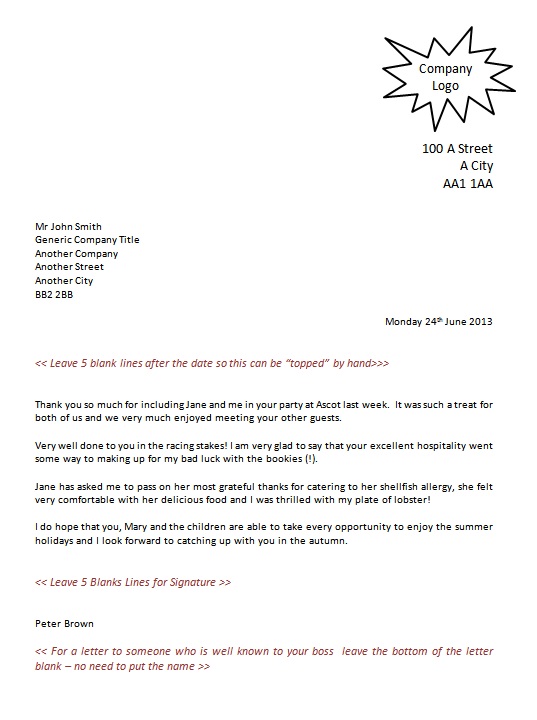
You could structure your letter like this:
  1. “Thank you for....” – this is the purpose of the letter and should be stated immediately
  2. Personal detail – this shows a great level of detail and therefore appreciation for the host’s efforts.
  3. What I/we liked about what you did for us – as above and shows that the writer is keen to nurture the relationship.
  4. Allude to the future – this is a positive way to conclude and can also be non-committal.
 An example of a generic business thank you letter:

It should be sent no later than the Monday after the event (to arrive on the Tuesday) or if your boss is travelling it should be waiting for signature upon their return. If there is a gap longer than a week between those days reference to the “lateness” of the thanks should be made in the first paragraph of the letter e.g. “Please forgive the time it has taken for me to thank you for including me/us <<etc>> I have been out of the country....".
I owe a great deal of this knowledge and the accomplishment of the finer details to Debrett’s. This is the definitive guide to getting things right in the minefield of communication and they now have a great deal of this information available on line. For me though, my copy of “Correct Form” is well thumbed and considered an office essential.

These tips should get you through the fear of the blank page staring back at your when you boss asks you to "Sort out a Thank You letter for...." Anticipating this need when you diarise and accept an invitation is a great way to demonstrate pro-active thinking. Set a reminder in your own diary, produce the letter in a timely matter, pop it in the signing book and your boss will start to think you're psychic!

Tuesday, 9 July 2013

The Basics: How to answer the phone in the office.

Yes, there is a correct way to answer the phone, it's one of those little things that make all the difference.


Picture this:
  • You’re sitting at your brand new desk.
  • You have a nice cuppa in front of you courtesy of your tour of the kitchen facilities.
  • You’re logged in.
  • You’re familiarising yourself with the diary your managing and…… the phone rings.


This is can be a heart-in-mouth-when-you-least expect it moment. If you’re in an open office this is your moment to prove yourself.  If you’re in a private office this is the first time you’ll represent this company/individual.  

You might think one or all of the following:
  • What if I stumble over my words?
  • What if I forget the company name?
  • What if I say the wrong thing?
  • What if the people sitting around me are all listening?
  • What if I suddenly forget how to speak?
  • What if I’m so laid back about it they all think I’m really unprofessional?
There is only one correct, courteous and professional
way to answer the phone:

 Within 3 rings and with the words
“Good Morning/Afternoon, Company Name”.
Obviously, this is not to be taken literally, please use the time of day and the company name appropriately. You can use the clock at the bottom right hand corner of your screen to check the time - it will always be there and it becomes second nature to glace at this before picking up the phone.
As for the company name – write it down clearly on a post-it note and stick it on or near the phone along with the direct dial number of that extension. Trust me – it is a real life-saver on days when you’re handing over, trying to learn new procedures, generally learning the ropes and concentrating on other things.
You will never be berated for answering the phone in the above manner; however, the perfectly correct way to answer that phone is the way that the person you are working for would like you to.
This is an excellent first day ice-breaker question if you are working at high-level. Often, you will have been engaged by the person you are covering, or by HR or another person who is unfamiliar with the role you will be required to do. Sometimes, winging it is not an option.
If the person you are representing is the kind of person who is conscious of how they are represented they will appreciate being asked this question. It shows that you are fully aware that you are the face/voice of their office and they will respect you for that.

NB Answering someone’s mobile is a little more personal. You should always establish if this is part of what is required of you before you do pick up someone’s mobile on their behalf. If it is part of your requirement you should answer with “Mr/Ms Example’s line, YourName speaking”